Howl at the Moon

I suppose I’m a couple weeks ahead of schedule with this blog entry—perhaps I should have waited until the next full moon, which as of this post is October 8th. C’est la vie.

As with my last post of Vlad’s mugshot, I originally illustrated this wolfman mugshot as clipart, where it’s still available for download from iStockPhoto.com. I’d love to hear what you think about my illustration, and if you’d like to see more, be sure to follow my blog to receive updates.
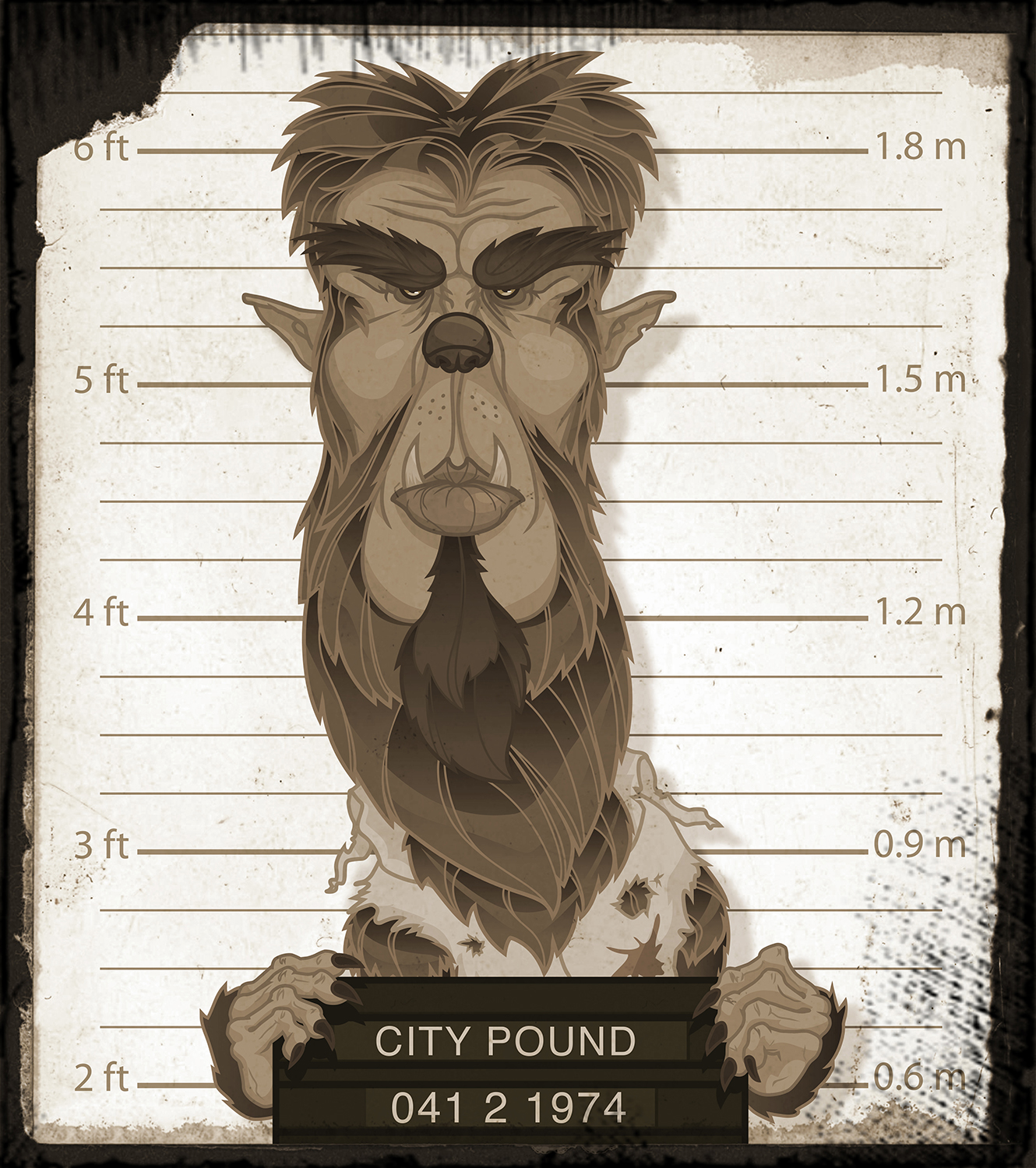
wolfman-vintage-mugshotAnd staying with tradition, I thought I’d give a condensed history of the wolfman, from myth to pop-culture. My sources vary from personal research to an assortment of web-based references.

Myths of werewolf-like beings date back to some of the earliest known literature, and nearly every culture has its own myths regarding shape-shifting entities of one form or another. The Greeks have a story of a King named Lycaon, who Zeus transformed into a wolf as punishment for Lycaon’s misguided attempt to test Zeus’s omniscience (spoiler alert: it didn’t go well for Lycaon). The paranormal term lycanthropy, which refers to the transformation of a human into an animal (most commonly a wolf, in modern pop culture), derives from Lycaon’s name.

Since the nineteenth century, the two most common forms of werewolves are the human-to-wolf transformation, and the human-to-wolfman transformation, both typically encouraged by the light of a full moon.

One of my favorite short stories was originally published in 1896 titled The Were-Wolf, written by Clemence Housman. It tells of a seductive woman who happens upon a wintery human establishment feigning the need for shelter, before turning into a white werewolf and killing a few hapless victims. According to Wikipedia, HP Lovecraft said of The Were-Wolf : “it attains a high degree of gruesome tension and achieves to some extent the atmosphere of authentic folklore”. HP summed it up nicely; I’ll leave it at that.

Skip ahead a few years, and we have the one of the most iconic versions of the wolfman-style werewolf via Lon Chaney Jr.’s The Wolf Man. My own clipart version of the wolfman was inspired by this 1941 movie, as were numerous subsequent films and graphic novels (including Stephen King’s Cycle of the Werewolf, Michael J. Fox’s Teen Wolf and Benicio Del Toro’s The Wolfman). As with many of the monsters from the Golden Era of Hollywood, Lon Chaney Jr.’s visual portrayal of the wolfman has provided the template for spin-offs, spoofs, cartoons, and an assortment of Halloween toys and paraphernalia for more than seventy years.

One of my all-time favorite portrayals of the wolfman is from Frank Frazetta’s painting, Dracula Meets the Wolfman. The image I’m including here is a modified version of the painting which I tweaked to work as a wallpaper on my computer. Feel free to download it for your personal use from my DeviantArt gallery.
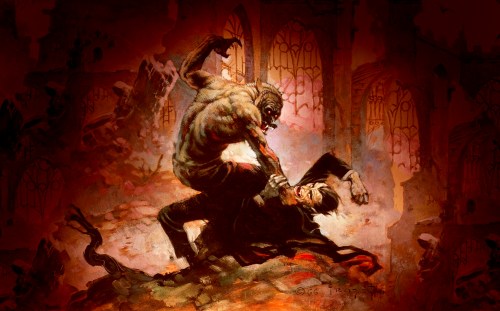
Film Title: The WolfmanI’ll end with a couple quick reviews of modern werewolf fiction of two different sets of novels that became instant favorites of mine. The first is Glen Duncan’s The Last Werewolf, which has spawned two sequels thus far, Talulla Rising and By Blood We Live (I’ve yet to read the latter). The first in the series is the first-hand account of a man named Jake who is, as the title suggests, the last known werewolf. Having lived more more than 200 years, he’s fighting his internal demons and considering putting an end to his long-lived existence. But a group of werewolf hunters, previously bent on destroying all werewolves, now want him very much alive, though they’re competing with a clan of vampires who want Jake for their own nefarious reasons. This new werewolf legend seems to mirror the visual representation of Frazetta’s painting, which I loved. The character of Jake was both stoic and witty, but showed real heart when he encountered a runaway named Talulla (whom he would eventually fall in love with). Masterfully written and fast-paced, this was a refreshing addition of the annals of werewolf literature.

The second review is of Graeme Reynold’s High Moor series (of which there are currently two, with more in the works). Graeme managed to stay true to traditional lore without muddying it up with cheesy explanations or half-hearted re-imaginings. It’s easy to accept the fact that werewolves exist in the small Scotland town of High Moor. The story is horrific yet gripping, keeping the reader on the edge of their seat. It inspired images of the movie The Howling, though far more vivid and terrifying than that dated movie was able to accomplish. I bought High Moor 2: Moonstruck as soon as I finished the first book, and the second was easily as good, if not better. An enjoyable factor in this legend is the dual stages of the werewolf. The average werewolves make a full transformation to an extraordinarily large wolf, though they retain full control of their faculties. “Moonstruck” werewolves, however, are caught halfway in-between, appearing wolf-like while retaining the upright, primate stature, but totally lacking in self-control. Reynolds is definitely an author I’ll be keeping an eye on, especially if he continues to deliver these refreshingly new classics.

One final note in regards to my clip art; I have to say that I’m pretty stoked about iStockPhoto’s new royalty program. All items (I believe) are either 1 or 3 credits. Previously, images could be up to 40 or 50 credits, if not more. So it really is a great deal, and it’s finally competitive to the other, cheaper clip art sites. If you get a chance, check out my iStockPhot.com portfolio. I’ve been a contributor there since 2008, with nearly 500 images available for download, and more than 12,000 images downloaded to date. Not a bad track record, if I do say so myself.

Until next time-

Bela Lugosi’s Not Dead

Halloween is right around the corner!

This is, by far, my favorite time of year. I love the change of season we’re afforded living in the Midwest, when the morbid humidity of summer fades into the crisp evenings of early autumn. You start the morning with a jacket, strip down to your t-shirt by noon, then relax in front of a backyard fire in the evening. The trees are a glorious combination of greens, golds, reds, and browns, making the weekend drive to the cabin all the more relaxing.

Of course, then there’s the All Hallow’s Eve festivities. Dracula and the Wolfman are once again relevant (you can keep your Power Rangers and Sponge Bob costumes—I’m a traditionalist when it comes to the most frightful of all unholy days). That said, I felt it was time to break out a few Halloween-inspired illustrations.

Vlad Vintage MugshotThe first is Vlad himself. I originally did this illustration as clipart for sale at iStockPhoto.com, where it’s still available for download for a mere 3 credits (up until the middle of September, this image would easily have been 20 credits, if not more. And while that doesn’t sound like something an iStock contributor like myself should be exited about, trust me, the cheaper my images, the more available they are to your average Joe. That makes me happy. But I digress…)

In honor of Vlad, I thought I’d include a condensed history of the most famous as well as infamous of all supernatural predators, Count Dracula.

He started as the lead antagonist in Bram Stoker’s vampire novel, where Stoker originally named the character Count Wampyr. But in the course of his research, Stoker stumbled upon the story of Vlad III, Prince of Wallachia, also known as Vlad Dracula, and the iconic vampiric namesake was born. The name translates to Son of the Dragon; Vlad II, Dracula’s father, was a member of the Order of the Dragon, earning him the name Vlad II Dracul (Vlad the Dragon). In present day, the name Dracul also translates to the more apt devil.

Vlad III Dracula’s penchant for impaling his victims earned him the nickname, Vlad Țepeș, or “Vlad the Impaler,” though the nickname was acquired well after his death. It’s widely understood that Stoker did very little research into the history of Vlad III; in fact, he was likely unaware of Vlad’s true bloodthirsty reputation. Stoker simply liked his name. There are a few accounts of the real-life Vlad dipping his bread into the blood of his enemies; how Stoker missed that, but managed to imbue the same yearning for blood into his title character is an amazing coincidence, to be certain.

But while Bram Stoker certainly gave birth to the fictional Dracula, it was Bela Lugosi who gave the elegant and feared vampire his pop-culture identity. When images of vampires appear in children’s cartoons or the seasonal paraphernalia at Target, chances are the characters are wearing a silky black cape, slicked-back hair with a widow’s peak, and a war medallion draped around his neck. Even Bela Lugosi’s accent has become the stereotype for vampires of both the theatrical and celluloid varieties. No matter how many vampires have come since (sorry Lestat and Edward), Bela Lugosi’s Dracula has retained the roll of most recognizable, even for those who have never seen the original film. My own clip art is a testament to this, if not a mere reflection.

In the coming days, the Wolfman, the Mummy, and Frankenstein’s Monster will all make an appearance in county lock-up, so follow my blog, check back often, and be sure to leave a comment to let me know what you think!

The Guy on the Shirt

Che Guevara was real. He existed. It’s true. He’s not just the face on a t-shirt.

But I didn’t know that. I mean, as with any bit of knowledge, none of us knew, until we learned it to be true.

Mi Che TeeMy interest in the man was born of ignorance. I grew up in a small farming community in rural, northeast Iowa; the son of a very loving, but politically indifferent couple. My parents certainly made it to the polls during voting season, but I can’t remember a single time when discussions of politics entered into our home. By extension, my own interest in politics was all but non-existent. If I had learned about the controversial Argentinian named Ernesto Guevara during any of my social or political studies during high school, I’ve long since forgotten.

To be clear, my discovery of Che Guevara was not recent. Sometime around the year 1999 or 2000, I was watching an episode of Fox’s That 70s Show, on which the character Hyde (played by Danny Masterson) wore a t-shirt with the iconic Che Guevara headshot. At that time, I don’t recall having ever seen that image before, and I admit I was curious who the guy was. Hyde was the resident rebel on the show, indifferent to social norms, immune to pressure from his peers, so I knew the figure on his tee must have been someone deserving of his rebellious admiration.

That said, I may have forgotten about the t-shirt altogether had it not been for another TV show later that same night, also on Fox, called Dark Angel. This was the show that gave both Jessica Alba and Michael Weatherly their first real brushes with fame. Dark Angel took place in the not-so-distant, post-apocalyptic future, where a character nicknamed “Eyes-Only” (played by Weatherly) ran a pirate Internet feed that would randomly hijack the inter-web and reveal government conspiracies. The interesting thing about that night’s episode was, Eyes-Only happened to be wearing the exact same t-shirt that Hyde wore not more than an hour earlier (give or take forty years). OK, not the exact shirt; Hyde’s tee was military-green, while Eyes-Only’s was oxford-gray. But what are the odds? I was intrigued, to say the least; now I definitely needed to learn who this guy was (and not for nothing, but the character Jessica Alba played was named Max Guevara).

Enter the “new car” effect. You know what I mean; when you buy a new car, you suddenly start seeing that exact same model wherever you go. Same thing happened here.Mi Che 01 A few short days following my introduction to the guy on the shirt, I happened to be looking for a font online. During the course of my search, I stumbled upon a handmade set of dingbats that included an icon-sized image of the mysterious man. I called upon the resident outsider where I worked; an individual by the name of Guy (a man who looked and acted as though he were the character Tommy Chong was attempting to mimic in Cheech & Chong’s Up In Smoke). I learned very early, while at this particular job, that Guy was a walking encyclopedia, at least when it came to 60s and 70s trivia. I showed him the icon, and he immediately revealed the name I’d been seeking; Che Guevara. He even followed this up with a boisterous, “Viva la revolución!” Yeah, thanks, Guy. I have no idea what you’re going on about. (Yes, I know what it means, now. I was being the 1999 version of myself.)

With name in tow, I went about searching the web for information about the guy on the shirt. Among the first things I found were websites selling t-shirts, stickers, and banners featuring the iconic image; an image I now know was taken from a photo by Alberto Korda. I considered buying a shirt; if it was cool enough for Hyde and Eyes-Only, surely it was cool enough for me, the whitebread rebel that I was. But I still didn’t know much about the guy on the tee, and frankly, I didn’t want to be a poser.

It was a couple years later, after I moved to the Twin Cities, that I Che-Coverstumbled upon Jon Lee Anderson‘s book, Che Guevara: A Revolutionary Life. I purchased it, and slowly set about reading it. The book was no quick read (at more than eight-hundred pages), though I found it difficult to put down. I entered it with only an inclination as to who Che Guevara was, but with that in mind, I was intrigued by the complex process through which Ernesto Guevara was transformed into the infamous symbol for the revolutionary spirit. The level of detail within the book was astounding; Anderson clearly did his research. And it didn’t read like a boring textbook, which was a bonus. Guevara led an extraordinary life, and that came across through Anderson’s words.

Did I walk away from the book liking the guy? Yeah, I kind of did. Anderson’s book was a very detailed examination of Che’s life, from the strong-willed youth, to the young, impressionistic doctor who took an incredible journey down the entire length of South America on a motorized bike. He was a powerful presence to all who encountered him; charismatic, charming, and even kind, if only a little sarcastic. He was well read and well educated; he sought knowledge wherever he roamed.

But he was also sympathetic to the indigenous peoples of the lands through which he traveled. He witnessed their oppression first hand, and more often than not, the root of said oppression was corporate greed. He saw no good coming from capitalism, at Mi Che 02least not for the people who’s blood and sweat provided the goods for their corporate masters. We all have skewed perspectives of the political climate as a direct result of our unique vantage points. Personally, I’m quite content living in Midwestern America, land of the free, home of the entitled. But had I grown up during the 50s and 60s in Central America, I’m certain my perspective would differ greatly from present-day me.

Of course, there were the “murders” he committed. I put that in quotations because, as documented in Anderson’s book, the men he condemned to death were far from innocent. There has been much said about this point; search the web now and you’ll find countless sites decrying Guevara as a murderous racist, the killer of innocents. But, in Anderson’s own words (and following more than five years of extensive research), “I have yet to find a credible source pointing to a case where Che executed an innocent. Those persons executed by Guevara or on his orders were condemned for the usual crimes punishable by death at times of war or in its aftermath: desertion, treason or crimes such as rape, torture or murder.”

I’m not justifying the murders, myself. Personally, I’m not a fan of killing. Just not my cup of tea. There’s at least one author, Humberto Fontova, who claims that Ernest Hemingway had been invited on more than one occasion to witness the executions while enjoying daiquiris. I don’t know that I believe this; Fontova’s source reads like, “I heard it from a guy who knows a guy…” Furthermore, I’ve read other articles suggesting that Hemingway was barely an acquaintance of Che or Fidel, having met them just once on a well-publicized fishing trip. But this is hardly relevant to my story about the guy on the shirt. Digression will get you nowhere.

And so back to the tee. After completing Anderson’s book, I sat down to sketch my own version of the iconic Che Guevara posterized portrait (yes, the sketches included here are original Mike Powers illustrations). Once completed, I had it screen printed onto a shirt of my own, so I could finally wear the design I’d seen on Hyde’s tee roughly four years prior. I knew, now, who this man was and what he stood for. My reason for wearing the shirt was not about the rebellious, counter-culture vibe it exuded, and it certainly had nothing to do with revolutions or uprisings (nor did it involve Rage Against the Machine). But I did respect the impact Che had, and continues to have, on the history of this shrinking world of ours. That’s why I wore the shirt. That’s why I continue to be fascinated by the man.

Shortly after my illustration was printed, I wore the tee to the Minnesota State Fair. At one point I was resting on a bench while my wife and mother-in-law were using the facilities, and a guy walked past me, taking notice of my shirt. He stopped and asked if I knew who the guy on my shirt was. He clearly assumed me ignorant of such knowledge. I explained to him that I knew quite a lot about the man, and with the fresh knowledge at hand from Anderson’s book, I went so far as to say that I probably knew more about him than your average joe; he was less than impressed. This stranger went on to explain how he, himself, was an immigrant from Cuba, and he recounted a time as a child when Che Guevara visited his classroom. He didn’t necessarily speak ill of Che, though there was no warmth in his tone; he clearly did not revere the man in any way. But I believe he was content to learn that I wasn’t some misinformed, young punk (I can call myself young–this was ten years ago), rather someone who merely held a perspective that differed from his own. It was an interesting encounter. How many people do you know who have actually met the guy on the shirt?

Earlier in this post I indicated that I didn’t wish to wear the tee without first gaining some knowledge of the guy who’s face adorned it, for fear of being called out as a poser. Che Guevara Blowing SmokeThis was an unfair judgement. If someone wants to wear the tee, they aren’t required to know who Che was or what he stood for. Nor should political or historical aficionados hem and haw about the nature of Che’s legacy being debased as a pop-culture trend. The truth of the matter is, the shirt has kept interest in the man alive in ways no book or biopic ever could. My own interest in him was born of the tee. I can practically guarantee I never would have picked up the book had I not first witnessed the dual instances of the shirt on Fox in a single evening. The shirt sparked my interest. And if it takes a blissfully ignorant youth wearing the shirt to inspire more people to pick up a book or do a little research online, so be it. You don’t have to walk away loving the man or agreeing with what he stood for, but educating yourself regarding the shared history of Cuba and America is definitely a positive thing. And if you are so inclined to read up on the guy on the shirt, you might as well start with Jon Lee Anderson‘s book.

From the Shelf

“I had learned already never to empty the well of my writing, but always to stop when there was still something there in the deep part of the well, and let it refill at night from the springs that fed it.”

― Ernest Hemingway, A Moveable Feast

There are two books that I’m currently submersed in; Hemingway’s “A Moveable Feast” and Roman Payne’s “Rooftop Soliloquy.” There’s no specific reason I chose to dive into both books at once. A coincidence, to be sure; while I was aware of the content Roman Payne’s novel (the adventures of a mysterious man as he makes his way through Paris, enjoying drink and girls with equal fervor, and searching for inspiration to complete his heroic opera), I knew little of Hemingway’s, aside from it being a tale from the earlier years of his adult life. I was intrigued by the prospect of getting to know a younger Hemingway, which is a contrast to my limited knowledge of the man. I loved “The Old Man and the Sea,” but outside of that, I know only of the entertaining quotes found on a plethora of internet memes, and the tale of his tragic end by his own hand. That, and the iconic image of the silver-bearded man with the world-weary eyes and the thick wool turtle-neck sweater. I know of “Papa Hem.” This younger fella, he’s new to me.

Thus far, I’ve been impressed with the similarities between the two books, if not in direct content, then certainly in tone. Both are the day-to-day accounts of men who find themselves immersed in cultures not their own, though very much their own. Both are considered works of fiction, and yet you can feel the true stories seeping through the cracks. Two men sharing experiences generations apart; Hemingway of the “Lost Generation,” and Payne of my own generation, the absently labeled “X.” I’ve never much cared for that label, though it’s better than the “MTV Generation.” I suppose it basically means the same thing, which is probably why I despise it.

Hemingway’s writing style is far simpler than Payne’s; Payne is a poet first, and that becomes apparent in the eloquence of his prose. Within “A Moveable Feast,” Hemingway describes his own writing as a bare-bones approach to story-telling, stripping away the flourishes and saying only what needs to be said in the simplest manner possible; a style that, amusingly enough, Gertrude Stein considered idiotic.

I’m anxious to finish the books, and fortunately, neither is prohibitively long. Perhaps I’ll revisit this post, add to my thoughts, expand on their similarities, reveal their differences. Perhaps I’ll leave the thoughts open, adrift, floating around in the ether. There’s clearly room for more in this particular well, though not every well needs to be filled to be complete.

Is This a Turning Point in Self-Publishing?

To anyone with an Internet connection and a love of literature, it’s obvious that self-publishing is the future of the book industry.

Self-published titles are up 17 percent just since 2012 and a whopping 437 percent over 2008.

Clearly (and much to the delight of readers), writers are finding themselves increasingly empowered by the leveling technology of software like Scrivener and SmashWords and online marketplaces like Amazon that, for better or worse, have proved crucial to the success of our industry while ripping power from the greedy, grabbing hands of the traditional gatekeeper publishers.

But make no mistake: behind all those ones and zeros, this historic success is cemented in the ever-lengthening line of remarkable novels, shorts, and series from self-publishing authors who’re using this modern technology to craft the kinds of stories that keep us all coming back for more.